About Addison Consulting

Services
- Simulation and analysis of fluid systems and structures (Using www.simerics.com software)
- Rotarian Rotary International (RI)
- Tutoring and Mentoring
Projects
Recent/Current Projects:
- RI Project GG 2021844: LifePumps in Senegal
- RI Project Maranatha Maternity Initiative Uganda
- Storm Wave-Structure Interaction in Rockport ME
- Trail-Walker Treadmill Design
About Addison Consulting
Addison Consulting is a sole owner LLC enabling Sam Lowry, as a retired manager and engineer, to continue to provide engineering services both commercially and as a volunteer. For Dr. Lowry's resume, see below.
Resume: Samuel Addison Lowry

Interests
- Engineering consulting
- Rotary International
Career History
- President, Addison Consulting LLC June 2016 to Present
- President/Co-Founder, Simerics Inc. (www.simerics.com) June 2006 to June 2016
- Science Teacher, Lee High School ( http://www.leehigh.org/ ) Aug. 2005 to May 2006
- Director Advanced Technology, CFD Research Corporation (www.cfdrc.com ) October 1991 to August 2005
- NASA Engineer, Analysis Branch MFSC (http://www.nasa.gov/centers/marshall/home/ ) October 1981 to April 1986
- Lieutenant, USMC (www.marines.com ) October 1975 to April 1978 (Active Duty)
Education
- PhD Engineering Sciences, University of Tennessee Space Institute (1990)
- Masters Mechanical Engineering, Case Western Reserve University (1980)
- AB Engineering and Applied Physics, Harvard College (1975)
Other Skills
- Computational Fluid Dynamics (CFD)
- Simple Russian and French
Actvitie & Hobbies
- Greater Huntsville Rotary Club
- Offshore sailing ( www.lillianb.net )
- Beginners Saxophone
- Travel
Deep-Water Hand Pumps for Senegal
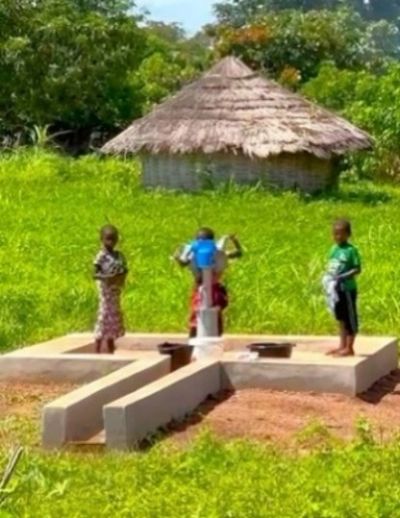
Senegal LifePump Project Final Report
Rotary International Project 2016844
Deep-Water Hand Pumps for Sénégal
Final Newsletter
January 2025
Overview
This is the final newsletter for the Rotary International Project 2016844, Deep-Water Hand Pumps for Sénégal. Nine years after first reading an article about LifePumpsTM in Malawi [1] and nearly five years after submitting the project proposal to Rotary International, all five LifePumpsTM shipped to Sénégal under the grant have been installed and are operational. The first three LifePumpsTM, installed in September, 2023 in the Sénégalese villages of Banding, Ninéfécha, and Afia-Magasin, continue to reliably produce water. The last two LifePumpsTM were successfully installed this past January 2025 in the villages of Asoni and Koussi in the remote Kédougou region of Sénégal. That trip marked the successful completion of the four key objectives of the original proposal: 1) installing five LifePumpsTMin Sénégal in villages with need of water; 2) training a local contractor in the installation and maintenance of the pumps; 3) introducing Office Des Forage Ruraux (OFOR), the Sénégalese governmental office responsible for rural water supplies, to the unique capabilities of the LifePumpTM, and 4) establishing local water committees and contacts to monitor the pumps.
Selecting the sites: As specified in the proposal, the sites for the LifePumpsTM were not dictated by the project but instead selected by OFOR, together with the local government. The original choices were the villages of Ethies Bas, Ethies Haut, Kessema, Angoussaka, and Lande Rounde situated high up on a plateau, 250 meters above the valley. The people of those villages have a dire need for water and, during the dry season, have to hand-carry a meager supply of water from a remote polluted stream. To drill the boreholes, the construction company Batifort had to employ a bulldozer to drag their heavy drilling rig up to the top of the plateau, then spent the next three months drilling six boreholes down to 150 meters. None of the boreholes struck water, leading to the conclusion that the water table is more than 150 meters below the surface, too deep even for a LifePumpTM. (A separate engineering proposal is being developed for the best means to provide water to those villages on the plateau.)
Given the hydrology of the original plateau, the decision was made to retreat to the valley and install three pumps down in the villages of Afia Magasin, Banding, and Ninéfécha. Those three pumps were installed in September 2023, followed by the installation of the two remaining LifePumpsTM during a recent return trip, this January 2025. These last two pumps were installed as retrofits for non-functioning Mark II pumps, using the original boreholes. The first of these, in Asoni, is also below the plateau but the last one was successfully installed in the village of Koussi in an 82-meter-deep borehole up on a neighboring plateau, 250-meters in elevation.
Training the local construction company: In addition to the humanitarian and engineering achievement of installing operational handpumps in five villages, another successful fulfillment of the project objectives was training the local contractor Batifort how to install and maintain those pumps. In this regard, the last trip in January 2025 was highly successful. Batifort engineers installed the final pump in Koussi entirely on their own. The Sénégalese construction company of Batifort is now considered to be fully self-sufficient in installing and maintaining LifePumpsTM.
OFOR involvement: Equally important was and is the increasing involvement of OFOR in the project. In addition to helping select the sites, the new OFOR director in Kédougou, Mr. Oumar Faye, offered one of his engineers Mr. Ousmane Badiane, to be directly involved with the installations of the last two LifePumpsTM. Based on communication between the branch OFOR office in Kédougou and the central office in Dakar, headed by Mr. Ameth KA, OFOR is now aware of the unique capabilities of the LifePumpTM, in particular as compared with the India Mark II pumps, prevalent in Sénégal. OFOR’s hands-on experience with installing and maintaining the pump, coupled with daily usage data provided via satellite, will enable them to make informed decision as to where the LifePumpTMwould provide a better return on investment for villages needing a deep-water hand-pump.
Local government involvement: The support of the local government was critical. On the very first trip out to Kédougou, the Regional Prefect, Mr. Thierno Souleymane Sow met with the Rotary Team and approved the program. This was supplemented by support from the Sous-Prefect, Mr. Youssou Faye during the project. Most impressive was the dedication, enthusiasm, and support of Mr. Dondo Keita, mayor of the Ninéfécha District. Mayor Keita rode multiple hours out to every potential site over roads that were barely passable to meet with the villagers and review the location. He was on hand for the installation of all five LifePumpsTM, including the last one, which was not in his district. The project would not have been possible without his help.
Design Outreach: Under this project, Design Outreach provided the LifePumpsTM and engineering support at cost. Design Outreach (www.doutreach.org) is a non-profit Christian organization that developed the LifePumpTM and has funded, installed, monitored and maintained them in over ten countries worldwide, including Central African Republic, Ethiopia, Guatemala, Haiti, Kenya, Malawi, Mali, South Soudan, Tanzania, Zambia, and Zimbabwe. Their home office is located at 224 W. Johnstown Rd. Gahanna, Ohio 43230, with branch offices in Lilongwe, Malawi and Lusaka, Zambia.
Monitoring the LifePumps
The five LifePumps purchased for this project each includes a transmitter that sends daily flow data back to Design Outreach via satellite. While not critical to the functioning of the LifePumpTM, monitoring the productivity of the pumps has three important benefits. First off, it provides a direct indication of whether the pump is functioning properly. This enables timely maintenance and repairs. Secondly, it provides specific data on how much water a village is using. This provides OFOR and the local government accurate statistics that they can use to quantify the return on their initial investment and justify the installation of additional LifePumpsTM. Thirdly, it provides feedback to all who have enabled this project through their generous support as to the ongoing benefit of their contribution.
For those interested in monitoring the LifePumpTM performance, Design Outreach has recently introduced a public dashboard that enables interested parties to directly access data on pump productivity. As such, anyone with access to the internet can monitor the pump performance.
https://do.bridgetreedcc.com/bt-do/public-dashboard
Below is an example of data transmitted from Asoni, one of the villages in Sénégal that recently received a LifePumpTM. The chart provides the hours of operation per day. At Asoni, the pump is currently being used for over 10 hrs each day, corresponding to approximately 850 gallons (3,200 liters) a day.
Additional LifePumps for Sénégal:
Under the scope of the LifePump Pilot Project GG20116844, five pumps were determined to be a sufficient number to test and demonstrate the unique capabilities of the LifePumpsTM to L’OFOR The ambition is that more LifePumps will be installed in the future based on their unique capabilities and better long-term return on investment coupled with an established process for purchasing, shipping, installing, and maintaining LifePumpsTMin Sénégal.
Since the Rotary Project GG20116844 is officially closed, funding for any additional LifePumpsTM pumps would need to come from other sources. The next goal of this project is to make any organization potentially interested in installing a hand pump in Sénégal, aware of the benefits of the LifePumpTM. This could be done by word-of-mouth along with formal presentations or articles at conferences and other media. For anyone interested, please feel to contact Rotarians Sam Lowry (samuel.addison.lowry@gmail.com) or Dwight Leeper (Dwight.Leeper@gmail.com) for help in facilitating the process.
Acknowledgements:
This project would not have been possible without the efforts and support of a wide range of organizations and individuals.
Design Outreach: I was personally inspired in 2016 by the humanitarian and engineering achievements of Design Outreach (DO) provided in an article by Amelia Messamore on the LifePumpsTM in Malawi[1]. That motivation led to discussions over the next few years with Greg Bixler, the president of DO, as to how one might help promote the LifePumpsTM. Those conversations led eventually to Greg’s support in accepting a proposal to introduce the LifePumpTM into a country other than one where DO was already engaged. DO agreed to provide the pumps along with engineering support, at cost.
Sénégal: The question then became, “what country?” With the aid of the internet, Sénégal quickly became the top choice. Sénégal boasts a stable government, religious tolerance, a central office (OFOR) actively working to improve rural water supplies, a good record with The World Bank on previous projects, an aquafer that runs underneath the country[2] and, as with many countries around the world, a desperate need for deep water hand-pumps to tap into subterrain water.
Rotary International: Once Sénégal was selected, another challenge was how to organize and finance a pilot pump project over in Africa. This is when long-time friend and Rotarian Dwight Leeper stepped in to play a key role. Dwight suggested using a Rotary International Global Grant for the enterprise. A Rotary International grant offered the advantage of matching funds and the power of an international network. A Global Grant Application requires an International Partner, in this case Dwight’s home club of West Chester Pennsylvania, and a Host Club in Sénégal, to be determined. This is where the global nature of Rotary was indispensable.
Dwight contacted his Rotarian colleague Jeffry Cadorette, who happened to be attending a District Governors Meeting in California in January of 2020. Mr. Cadorette was attending the meeting along with Mr. Christophe KOREKI, the incoming Governor of the District 9101 West Africa. Mr. Cadorette informed Mr. KOREKI of the proposal and Mr. KOREKI subsequently recommended contacting Mr. Baba TALL, the then president of The Dakar Soleil Rotary Club in Sénégal. Very soon after our the initial contact with Mr. TALL, the Dakar Club agreed to serve as the Host Club and, with the guidance of several experienced Rotarians like David Massy, a proposal for the project was prepared and submitted in June of 2020. That grant would be awarded the following January.
The Dakar Soleil Club: This project could not have been successfully accomplished without the assistance of the Dakar Soleil Rotary Club under the leadership of the four presidents during the course of the project: Baba TALL, Asthou MBAYE, Badou DAFE, and Ghislain DOREGO. Among other tasks, the Dakar Club helped with importing the equipment into Sénégal. Very special recognition and thanks also go to Club Member Sabina Guerrero and her husband Isah Skrijelj. They not only welcomed the team from the US into their home, but Sabina was also instrumental in establishing meetings with OFOR and identifying and contracting the construction company Batifort to do the work. And, as a pilot, Isah flew us across Sénégal for the first visit to Kédougou.
The Contractor Batifort: Batifort, the contractor that drilled the boreholes and installed the LifePumpsTM deserves extensive credit for their skill and persistence in the face of adversity. The director of Batifort is Emmanuel, Fangnon Agbegnigan. His crew includes technicians Koi Norbert and Ali Gueye. Training in the installation and maintenance of the LifePumpsTM was provided onsite by Ray Ehrig Design Outreach, who donated his time and travel costs on his last visit.
Batifort, undaunted by the challenge of dragging their massive drilling rig up to the top of the plateau
Also essential to the operation were Jallow Foday , Driver and Mechanic, and Vincent Keita, who served and continues to serve as a contact with Mayor Keita and the villages, and as the liaison for the project.
Ray Ehrig of Design Outreach (Center) Batifort engineer Koi Norbert (Left), mechanic Jallow
provides training to Batifort engineer Foday (Center) and Batifort engineer Ali Gueye
Koi Norbert (Left) as Vincent Keita translates (Right) putting the pump assembly together
Dakar Soleil Rotarian Sabina Guerrero (Left) Rotarians Sam Lowry (Left) and Dwight Leeper
and Sénégalese villager (Right) operate (Center) test the new LifePumpTMin Afia Magasin
the LifePumpTM in the village of Banding as mechanic Yallow Foday (Right) looks on
Mayor Dondo Keita speaking at the dedication of three LifePumpsTMin his District
with the Kédougou Prefect, Thierno Souleymane Sow, listening over his left shoulder
Donors
The donors: A point of pride for this project is that it was funded by a diverse range of “grass-roots” donors including one Rotary District, four Corporations/NGOs, twelve Rotary Clubs, and over 60 individuals. Thank you to everyone for your support.
References
[1] “Pump Technology Changes Communities” Exclusive coverage from Zambia & Malawi by Amelia Messamore 04/27/2015
[2] Regional Water Supply Planning with Renewable Energy Technologies: The Case of Senegal
by Eric J. Schiller, Department of Civil Engineering, University of Ottawa, Ottawa, Canada
[3] For Facebook images and commentary on the project, visit:
https://www.facebook.com/LifePumps-Deep-Water-Pumps-for-Senegal-102088411976058
Trail-Walker Treadmill
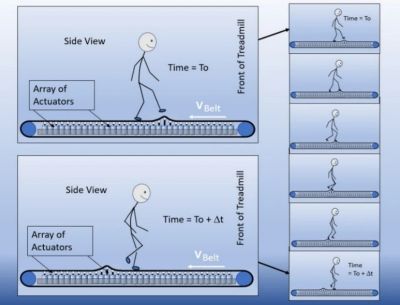
Trail-Walker Treadmill Design
Current treadmills do not offer simulation of an individual walking on an irregular surface. The proposed innovation would simulate that experience by creating a cascading array of mechanically generated features, i.e. bumps, underneath the belt of the treadmill. The features are then sequentially reproduced to move at the same velocity as the belt.